
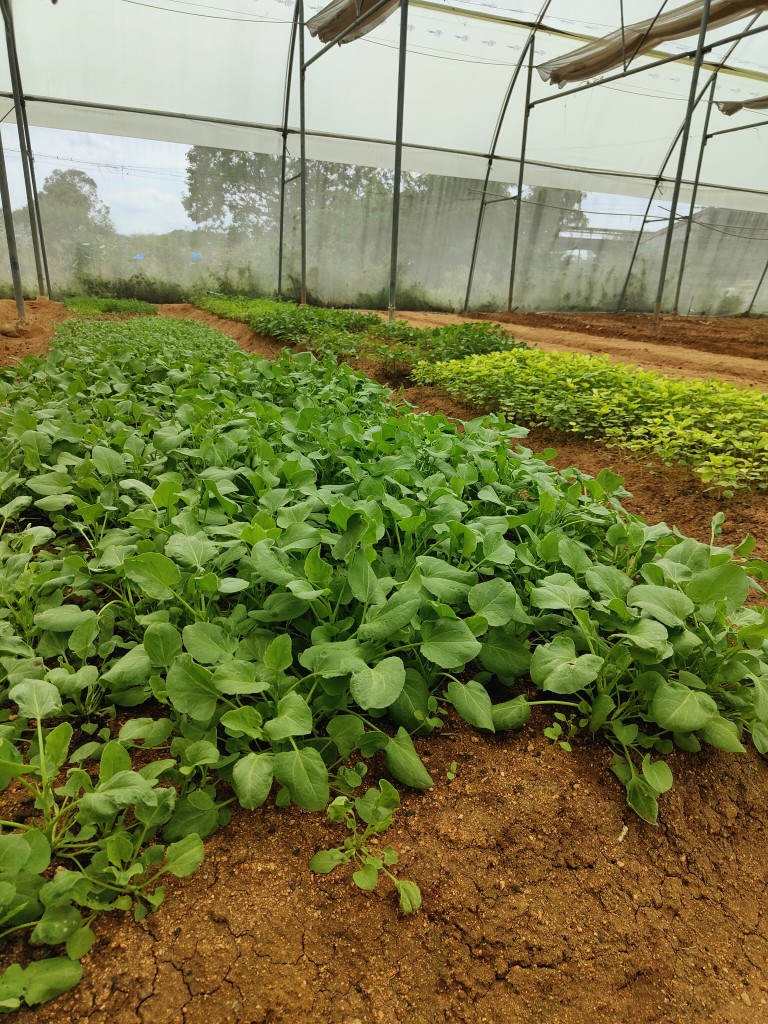
At the farm, we grow most of the vegetables we eat. It is done without the use of any chemicals—no pesticides, no synthetic fertilizers. Everything is grown in tune with the seasons, using natural methods. The focus is not only on producing food but on creating a way of farming that is gentle on the soil, on the creatures around us, and on the people who eat from it.
A Volunteer-Run Garden
Over the years, the vegetable garden has been cared for largely through the efforts of volunteers. Friends, visitors, and guests often join in to help with sowing, weeding, watering, and harvesting. Their time in the garden becomes an exchange: they learn about organic practices, and their contribution keeps the garden alive and diverse.
From time to time, agriculture interns also spend a few months here. They come with the purpose of learning more deeply about organic farming—how to grow without chemicals, how to work with soil health, and how to observe the rhythms of plants and insects. Their presence adds energy, new perspectives, and steady care to the fields.
Why Organic Matters
To grow organically is to be sensitive to life in all forms. It means noticing that the soil is not just dirt, but a living system full of worms, insects, and microbes. It means understanding that birds, bees, and butterflies are not outsiders, but partners in the cycle of growth. Farming in this way is built on compassion—caring not only for our own needs but also for the life around us.
Chemicals, on the other hand, cut through this web of relationships. Pesticides kill not just harmful insects but also bees, butterflies, and many others that keep the ecosystem balanced. Synthetic fertilizers may boost growth in the short term, but they exhaust the soil, pollute water, and ultimately weaken the very ground we depend on. And when we eat food grown with these chemicals, we carry some of those poisons into our own bodies.
Food and Responsibility
In today’s world, it is easy to forget the link between what we eat and how it is grown. Vegetables appear on shelves, neat and uniform, but hidden behind them are practices that may harm the soil, the farmers, and the consumers themselves. Choosing organic is not just about avoiding chemicals—it is about taking responsibility for what we put into our bodies and into the earth.
Every seed planted, every meal eaten, is part of a larger circle. When we farm with care, the benefits spread outward: healthier soil, safer water, more birds and bees, and food that nourishes without harm. When we disregard this, the damage also spreads outward—to ecosystems, to communities, and to our own health.
Looking Ahead
Our organic vegetable garden is not perfect or large-scale, but it is meaningful. It is cared for by many hands, grown in its own season, and eaten with gratitude. It is a reminder that farming can be simple, compassionate, and connected—and that the way we grow our food shapes not only our health but the wellbeing of everything around us.