
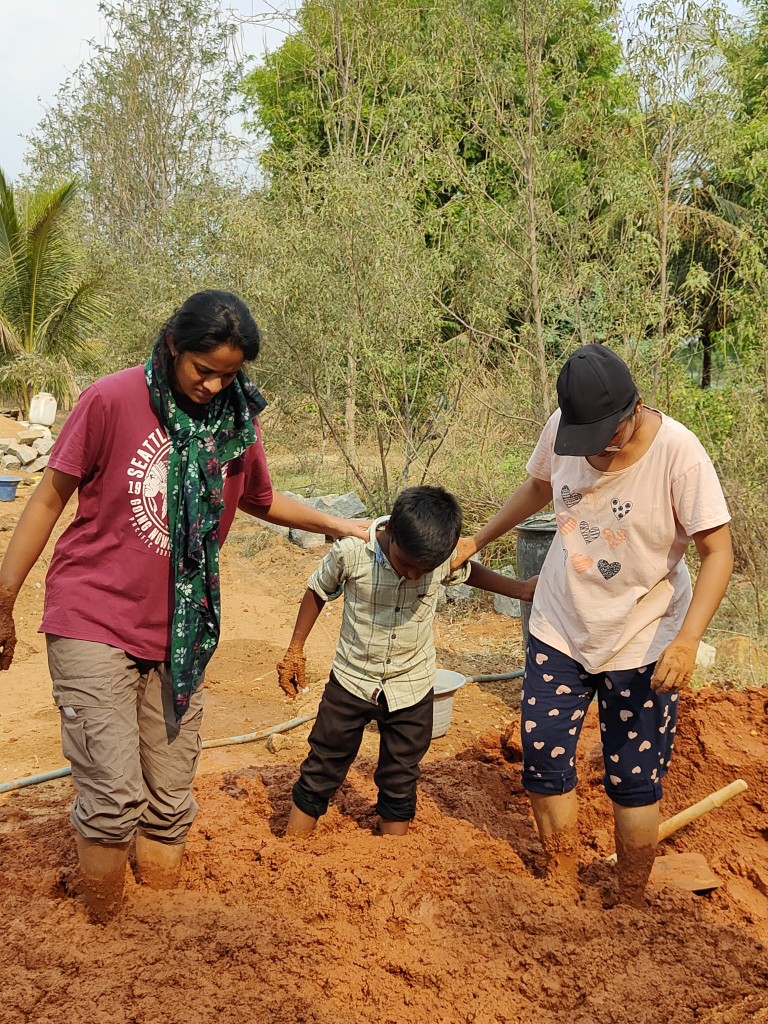
At our farm, we are trying to explore ways of living that are closer to nature—not only in the food we grow but also in the spaces we create. Last year, we hosted a workshop on building with mud, and what began as construction turned into something much deeper: a joyful reminder of our connection with the earth and each other.
Preparing the Mud
We began by bringing in mud from nearby hills and testing its composition with architect friends experienced in earth construction. The right balance of clay, sand, and silt is essential: too much clay leads to cracks, too much sand to crumbling. Once satisfied, we cleared larger stones, piled the soil, made a hollow at the center, added water, and started mixing.
No machines were used—only our feet. Walking, pressing, and folding the earth into itself became a meditative rhythm. The cool textures against the skin, the playful slipping, the laughter of children and elders alikewas a sight to see! Children as young as four joined in, alongside elders in their seventies, everyone leaning on one another for balance and encouragement.
Shaping the Wall
When the mud reached the right consistency, we carried it by hand to the wall. Layer upon layer, palms pressed and shaped it into form. The simplicity was striking—anyone could do it. This was how homes were once built: directly by the people who would live in them, with materials drawn from their own surroundings.
Homes Then and Now
For most of history, families built their own shelters. Each wall bore the imprint of its makers. Homes were alive with memory, skill, and belonging. Today, however, houses are built almost entirely by contractors, machines, and distant materials—cement, concrete, steel.
Cement and concrete have become the standard, but they come at a cost. They consume huge amounts of energy to produce, damage ecosystems, and create buildings that feel cold and lifeless. These materials seal us off, leaving little room for touch, warmth, or connection.
Mud as a Living Material
Mud is the opposite. It breathes, regulates temperature naturally, and maintains comfortable humidity indoors. Its ecological impact is minimal compared to cement. But even more importantly, mud invites participation. It asks for human touch, patience, and community effort. The very act of building with it creates bonds—between people, and between people and the land.
A Collective Experience
The wall we built holds more than earth; it holds moments of joy, stories, and shared energy. It was not just about creating shelter but about creating relationships. In a world where so much is outsourced and disconnected, this kind of hands-on building is a way to ground ourselves again.
Closing Reflection
A home is more than walls and roofs—it is the living space that shapes our daily rhythms. Building with mud reconnects us to the essence of shelter: simple, ecological, and deeply human. Far from being outdated, it offers a way forward—a future where our homes breathe with the earth and our communities grow stronger through the act of building together.